
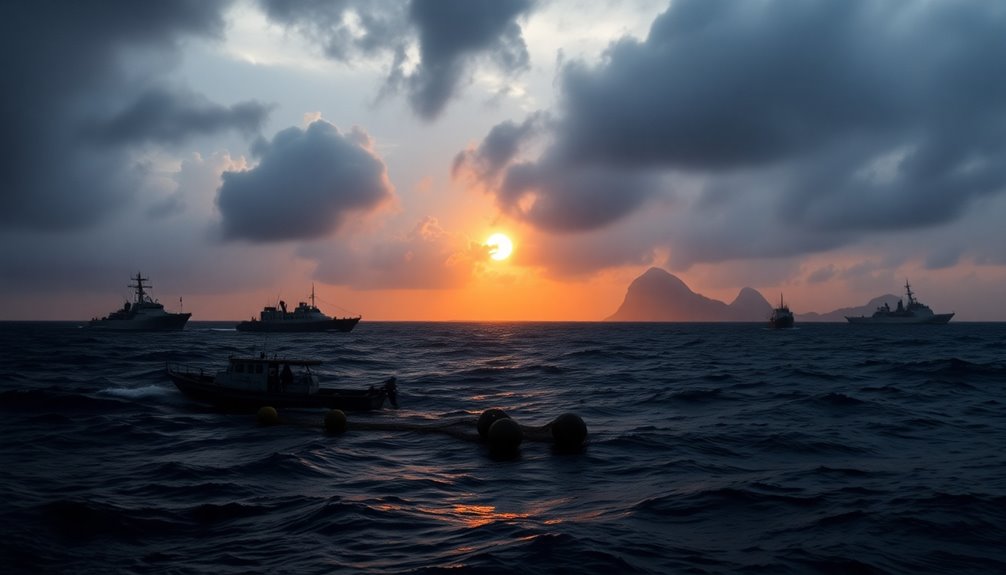
South China Sea Tensions Rise: Trade, Territory, and the Threat of Conflict
Subtitle
The Scientific Journal for Everyone – When scientists speak human, people listen.
Summary
The South China Sea — a vital waterway for $3.5 trillion in annual trade — is once again a flashpoint for rising tensions.
In 2025, China’s militarization of disputed reefs, new security pacts in the region, and increasing U.S.-Philippine patrols have escalated confrontations at sea. The risk of miscalculation is growing.
This article unpacks what’s driving the latest escalation, how the conflict over sovereignty threatens global trade and energy flows, and what role diplomacy, international law, and deterrence can play in keeping peace in one of the world’s most contested regions.
Why It Matters
The South China Sea isn’t just a regional dispute — it’s a global pressure point:
-
One-third of global shipping passes through it.
-
Its waters are rich in fish, oil, and gas.
-
Seven nations claim overlapping territory.
-
China has constructed artificial islands with military runways and radar systems.
-
The U.S., EU, and others consider freedom of navigation in the area essential.
A conflict here could disrupt global supply chains, raise energy prices, and destabilize the Indo-Pacific — with ripple effects worldwide.
What the Research Says
1. Tensions are rising, fast
-
In early 2025, Chinese coast guard ships blocked Philippine resupply missions to Second Thomas Shoal, escalating a standoff.
-
U.S. and Australian warships have increased “freedom of navigation operations” (FONOPs) near disputed reefs.
-
Vietnam and Malaysia have increased patrols and publicized maritime boundary violations.
-
Beijing passed a new law in July 2025 allowing its coast guard to detain foreign vessels and citizens without trial.
According to CSIS, incidents between military vessels in the region have doubled since 2022.
2. China claims almost the entire sea — but it’s legally disputed
-
The “Nine-Dash Line” map used by China has no basis in international law.
-
In 2016, a tribunal in The Hague ruled in favor of the Philippines, saying China’s claims had “no legal basis.”
-
China rejected the ruling — and doubled down militarily.
International law is clear, but enforcement is weak.
3. The South China Sea is essential to global trade
-
$3.5 trillion in trade flows through its waters annually — including energy imports for Japan, South Korea, and China.
-
More than 40% of global liquefied natural gas (LNG) passes through the strait of Malacca into the South China Sea.
-
A naval blockade or conflict would spike global shipping costs and insurance premiums.
The region’s stability is tied to global supply chain resilience.
What’s Behind It
1. Strategic ambition and nationalism
-
China’s push to dominate the South China Sea reflects its broader ambition for regional hegemony.
-
Domestic political pressure and “core interest” rhetoric make compromise difficult.
-
The Communist Party frames the sea as a non-negotiable part of China’s sovereignty — despite international law.
Territory and national pride are fused.
2. U.S. containment and alliance building
-
The U.S. has reaffirmed its defense treaties with the Philippines and Japan.
-
New pacts, like AUKUS (Australia-UK-US) and expanded QUAD exercises, show a growing military presence.
-
Beijing views these moves as encirclement — and has increased its own deterrence measures.
The strategic rivalry is becoming more militarized — and less diplomatic.
3. Resource competition and economic insecurity
-
The sea is rich in fisheries that are critical for food security in Southeast Asia.
-
Oil and gas reserves remain largely untapped — but are increasingly targeted by state-owned enterprises.
-
China’s “gray zone” tactics — using fishing fleets and coast guards — blur the line between commercial and military activity.
Economic pressure is part of the playbook.
What’s Changing
1. Growing military presence — and risk
-
All parties are increasing their patrols, surveillance, and air force presence.
-
“Near misses” between ships and aircraft have grown more frequent — with risk of escalation.
-
New weapon systems on Chinese outposts include anti-ship missiles and long-range radar.
Accidents can spiral into crisis.
2. Southeast Asian states are speaking out — cautiously
-
The Philippines, Vietnam, and Indonesia have begun pushing back publicly — but remain wary of fully aligning with the U.S.
-
ASEAN is divided, and China’s economic leverage remains strong.
-
However, growing domestic pressure and nationalist sentiment are forcing leaders to act.
Middle powers are asserting more agency — but at high risk.
3. The sea is becoming a testing ground for global order
-
Freedom of navigation is being contested not just by China — but in global precedent.
-
Legal rulings are ignored; military might decides facts on the water.
-
As the U.S. and China compete globally, the South China Sea is a proxy for broader norms and power.
What happens here may shape the rules everywhere.
Big Picture
The South China Sea is a symbol of 21st-century geopolitics:
Interdependence + insecurity + unclear red lines = permanent tension.
It’s not likely to erupt into full-scale war — but the risks of accident, escalation, and coercion are growing.
Whether the world can manage these risks depends on:
-
Maintaining open communication between militaries
-
Strengthening international maritime law
-
Empowering regional diplomacy
-
Avoiding “strategic fatalism” — the idea that conflict is inevitable
Conclusions
1. The South China Sea is a global security issue
Its importance extends far beyond Asia. What happens here touches trade, law, and peace worldwide.
2. China is not backing down — and others are pushing back
This is not a short-term dispute. It’s a long-term contest of resolve, strategy, and economic weight.
3. International law is only as strong as the actors behind it
Without enforcement or multilateral unity, rules erode — and power fills the vacuum.
4. Economic costs of conflict would be enormous
Even limited clashes would disrupt global trade, spike energy prices, and destabilize markets.
5. Diplomacy remains the only durable solution
Managing risk, not eliminating it, is the real challenge.
The Deeper Lesson
The South China Sea teaches us that in the 21st century, power is maritime, trade is security, and maps matter more than ever.
But peace will depend not on who claims the sea — but on who’s willing to keep it open.
Sources
-
Center for Strategic and International Studies (2025). Asia Maritime Transparency Initiative
-
International Crisis Group (2024). Standoff in the South China Sea
-
United Nations Convention on the Law of the Sea (UNCLOS)
-
Reuters (2025). “Philippine Ship Hit by Chinese Coast Guard Water Cannon”
-
BBC (2025). “U.S. and China Trade Blame Over South China Sea Standoff”
-
ASEAN (2024). Regional Cooperation on Maritime Disputes
Q&A Section
Why does the South China Sea matter globally?
Because of its trade routes, energy flows, and legal precedent. What happens there affects everyone.
What is China’s claim based on?
The “Nine-Dash Line” — a historical claim rejected by international law.
Is the U.S. trying to provoke China?
The U.S. argues it’s defending freedom of navigation; China sees it as containment.
Could this become a war?
Unlikely — but miscalculation or accident could trigger escalation.
What can reduce tensions?
Clear communication channels, regional diplomacy, multilateral enforcement of maritime law, and mutual economic restraint.
