
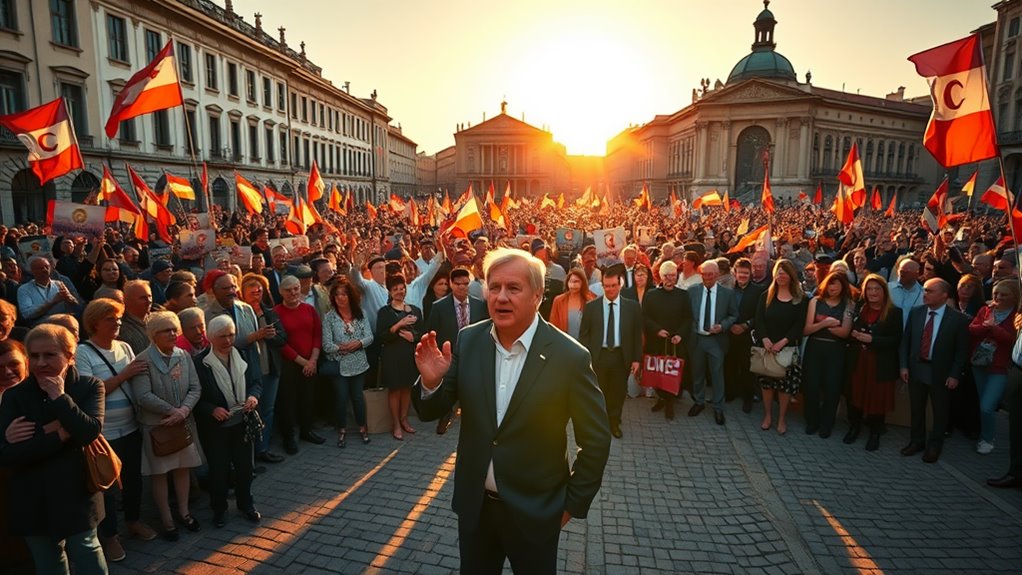
The Rise of Right-Wing Populism in Europe: What It Means for Policy
Subtitle
The Scientific Journal for Everyone – When scientists speak human, people listen.
Summary
Right-wing populist parties are no longer fringe actors in European politics. From Italy and Hungary to France and Sweden, their presence is reshaping national debates and the European Union’s institutional landscape. What was once seen as a political backlash is now becoming a new center of gravity.
But beyond the headlines and rhetoric, what does the rise of right-wing populism actually mean for public policy? The answer is complex. Populist governments often govern more pragmatically than they campaign, yet their presence changes the language, pace, and direction of policy—particularly in areas like migration, welfare, sovereignty, and the rule of law.
Why It Matters
This is not just a political trend—it’s a structural shift in how European democracies function.
-
Populist parties now control or influence governments in over a third of EU member states.
-
Traditional parties are repositioning to avoid losing voters—often adopting tougher stances on migration and identity.
-
EU institutions face growing internal conflict as Eurosceptic voices push back against integration and conditionality.
-
Public discourse is polarized, making compromise and long-term planning more difficult.
-
Marginalized communities and democratic norms are increasingly vulnerable to scapegoating and institutional erosion.
In short: Right-wing populism is not only a challenge to liberal norms—it is already reshaping the policy frameworks of European democracies from within.
What the Research Shows
-
Electoral success is rising steadily: Right-wing populist parties now control around 20–25% of the European Parliament and up to 30–40% of national parliaments in countries like Italy, Austria, and France (ParlGov, 2024).
-
Migration is the most consistent policy driver: Across the EU, populist influence correlates with stricter asylum rules, detention policies, and border security expansion (EUI, 2023).
-
Rule of law concerns are escalating: Populist-led governments in Hungary and Poland have implemented judicial reforms and media laws that weakened democratic checks and triggered Article 7 proceedings (EU Commission, 2024).
-
Welfare nationalism is replacing welfare universalism: Populist parties promote “social spending for nationals only,” reshaping public services in ways that exclude immigrants or minorities (LSE Migration Policy Review, 2023).
-
Populism correlates with policy volatility: Studies show higher reversal rates in environmental, health, and fiscal policy when populist parties enter coalitions (OECD Governance Unit, 2023).
The research confirms what citizens already feel: the populist turn is more than rhetorical—it is regulatory, legal, and institutional.
What’s Behind It
The rise of right-wing populism is driven by deep structural discontent, not just personality politics.
1. Economic Inequality and Regional Disparities
Decades of uneven growth, deindustrialization, and urban-rural divides have left many feeling economically left behind, especially in the peripheries of Southern and Eastern Europe.
2. Migration and Cultural Anxiety
Rapid demographic changes—real or perceived—have fed into fears of identity loss, job competition, and community change, often amplified by social media and disinformation.
3. Loss of Political Trust
Many voters feel mainstream parties are corrupt, out of touch, or unable to deliver on promises—creating demand for “outsider” figures who reject elite consensus.
4. Perceived EU Overreach
Some populist narratives frame Brussels as a remote bureaucracy undermining national sovereignty, especially on migration quotas, fiscal rules, and judicial independence.
5. Media Ecosystems and Digital Mobilization
Alternative media platforms and influencer ecosystems allow populist parties to bypass traditional gatekeepers and directly mobilize loyal online communities.
Together, these forces create a political space where emotive, anti-establishment messaging thrives, even when evidence and policy coherence do not.
What’s Changing
The normalization of right-wing populism is already changing European governance:
-
Mainstream parties are shifting right: To hold onto voters, centrist parties across Europe have adopted stricter migration rhetoric, tough-on-crime policies, and critiques of EU bureaucracy.
-
Coalition dynamics are evolving: In countries like Sweden, Italy, and Finland, right-wing populists have entered or supported governing coalitions, directly influencing policy agendas.
-
Democratic norms are more contested: Concepts like judicial independence, academic freedom, and press pluralism are increasingly politicized, with populist governments framing oversight as “foreign interference.”
-
EU policy is under strain: Rule-of-law conditionality, climate targets, and defense cooperation face resistance from Eurosceptic or nationalist actors within the European Council.
-
Civil society is under pressure: NGOs, media outlets, and universities in Hungary, Slovenia, and beyond face funding cuts, legal harassment, or discrediting campaigns.
We are witnessing not a policy revolution—but a slow, deliberate erosion of liberal policy foundations in the name of sovereignty and cultural protectionism.
Big Picture
Populism does not govern in a vacuum. It governs by reshaping the institutions, priorities, and language of the state.
-
Can Europe maintain social cohesion under cultural polarization?
-
Can the EU survive sustained internal resistance to its core values?
-
Can national policies remain inclusive and evidence-based under emotional populist pressure?
In short: The rise of populism is not just about elections—it’s about rewriting the policy agenda itself.
Conclusions
The challenge of right-wing populism in Europe is not hypothetical. It is already shaping policies, budgets, and norms—often subtly, but cumulatively.
1. Policy drift is more dangerous than policy shocks
Even when populists don’t win outright, their influence shifts the center of gravity, making exclusionary, regressive, or anti-democratic policies seem normal.
2. Migration remains the gateway issue
Populist parties use migration as a symbolic umbrella for broader grievances—economic insecurity, identity loss, elite distrust—making it central to every policy debate.
3. Institutional guardrails matter more than ever
Independent courts, regulatory agencies, and media watchdogs are crucial in preventing the erosion of norms. Their funding and legitimacy must be protected.
4. Reconnecting with disaffected voters is essential
The populist surge is also a sign of failure in social inclusion. Policies must address regional inequality, insecure work, and democratic alienation—or the appeal of “strongmen” will grow.
5. Europe must choose between cohesion and fragmentation
The EU can tolerate political diversity, but not at the cost of core principles. The challenge is to enforce those principles without deepening divides—a task that requires courage, clarity, and compromise.
The deeper lesson
Populism is not simply a revolt—it’s a request for recognition. But when recognition comes wrapped in exclusion, nationalism, and anti-democratic tactics, it risks weakening the very institutions needed to make democracy work.
The question is no longer whether populism will rise. It has.
The question is whether democratic systems will adapt intelligently, resist erosion, and offer real alternatives.
Without that, populism may not just influence policy—it may become the new policy default.
Sources
-
ParlGov (2024). European Party Systems and Populist Strength
-
EUI (2023). Migration Policy Shifts in Populist Regimes
-
EU Commission (2024). Rule of Law Report
-
LSE (2023). Welfare Nationalism in European Populism
-
OECD (2023). Policy Volatility and Populist Governance Trends
Q&A Section
Are all populist parties far-right?
No. Populism exists across the spectrum, but in Europe today, the most electorally successful versions are nationalist, anti-immigrant, and socially conservative.
Do populist parties always change policy radically?
Not always—but their influence often shapes discourse, budget priorities, and the scope of debate, even when constrained by coalition politics.
Is populism anti-democratic?
Populism often claims to defend “the people,” but undermines liberal democratic checks and balances, especially when in power.
How has the EU responded?
The EU has deployed legal and financial tools, such as rule-of-law conditionality, but its effectiveness is mixed, especially when member states veto sanctions.
Can populism decline?
Yes—if underlying economic and social grievances are addressed, and if mainstream parties rebuild trust through inclusive, responsive governance.
