
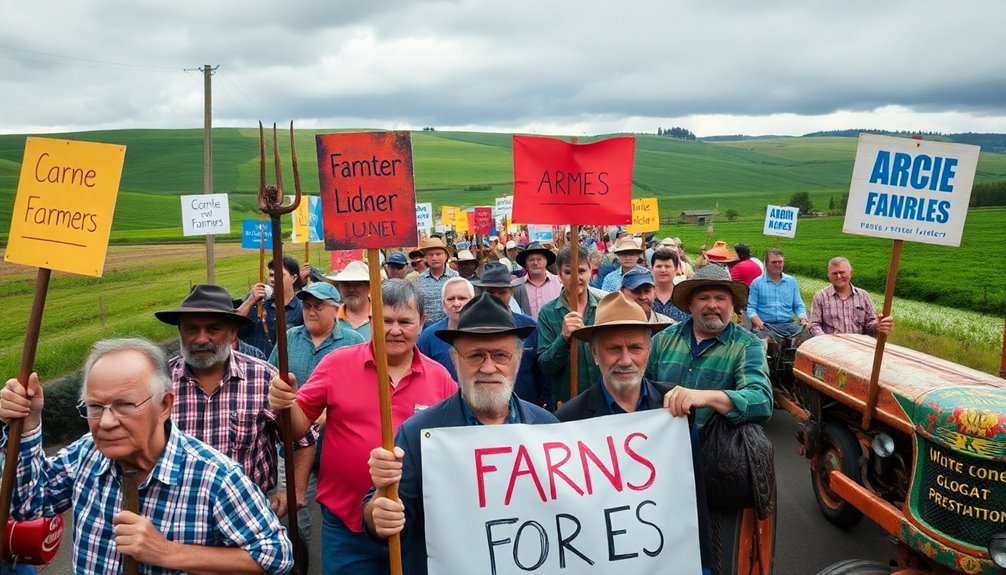
France’s Farmers Are Back in the Streets — Here’s Why It Matters
Subtitle
The Scientific Journal for Everyone – When scientists speak human, people listen.
Summary
The tractors are back on the roads. Hay bales are burning. Supermarkets are barricaded. And French farmers—long considered the backbone of the nation—are once again in open revolt.
But this time, the protests go far beyond fuel taxes or pesticide regulations.
In 2025, French farmers are demanding not just economic relief, but systemic reform. From rising input costs and suffocating debt to EU green policies and unfair trade competition, farmers say they’re being crushed by contradictory demands: produce more, pollute less, earn less, and survive.
This article dives into the complex reasons behind the mobilization, examines the broader implications for EU agricultural policy, and reflects on what the crisis says about rural identity, political trust, and the future of food in Europe.
Why It Matters
Agriculture in France is not just an economic sector—it’s cultural, social, and political:
-
France is Europe’s top agricultural producer, and a leading voice in Common Agricultural Policy (CAP) negotiations.
-
Rural areas are increasingly becoming hotbeds of political discontent, with far-right parties gaining ground.
-
The protests challenge the credibility of EU climate policies, especially the Green Deal’s goals.
-
Food sovereignty, biodiversity, and farming livelihoods are all being negotiated simultaneously—under pressure.
What’s happening in the fields of France could reshape agricultural politics across the continent.
What the Research Says
1. French agriculture is under massive economic strain
-
Input prices (fuel, fertilizer, machinery) have risen by over 30% since 2020 (INSEE, 2024).
-
Meanwhile, output prices (for milk, wheat, pork) remain volatile and often too low to cover costs.
-
Debt levels are rising: nearly 1 in 3 farmers now carries unsustainable loans, particularly among younger and mid-sized farms.
The economic model is broken—and scale alone doesn’t guarantee survival.
2. EU climate and trade policies are increasing pressure
-
Farmers face tighter rules under the European Green Deal, including pesticide bans, fallow land mandates, and emissions limits.
-
Many support sustainability in principle—but criticize poor implementation, lack of support, and bureaucratic overload.
-
Trade deals with countries like Canada and Mercosur are viewed as undercutting EU standards with cheaper imports.
Farmers say they are being asked to green their practices—without fair market protection.
3. The rural-urban divide is growing
-
A 2024 Eurobarometer survey showed rural residents are 40% more likely to feel “abandoned” by national institutions than urban dwellers.
-
Access to services, labor shortages, and youth migration are worsening rural social cohesion.
-
Protest slogans like “We Feed You” reflect a demand for recognition—not just revenue.
Agriculture has become a proxy for a broader rural identity crisis.
What’s Behind It
1. A perfect storm of inflation and insecurity
-
Energy price spikes following the war in Ukraine and Red Sea disruptions hit fuel-dependent farms hard.
-
Climate shocks—droughts, floods, and unseasonal frosts—have made yields more unpredictable.
-
Crop insurance schemes remain limited and expensive, especially for small-scale producers.
Volatility is the new normal—but safety nets haven’t caught up.
2. CAP support is increasingly conditional
-
The Common Agricultural Policy (CAP) still allocates nearly €55 billion a year—but rules have shifted.
-
Payments are now linked to “eco-schemes” and “conditionality” rules that many farmers find hard to meet without technical help.
-
Administrative burdens—from digital compliance apps to paperwork—take time away from farming.
For many, CAP feels more like punishment than partnership.
3. Political alienation and populist resurgence
-
Marine Le Pen’s Rassemblement National has gained support in rural regions, claiming to “defend the countryside.”
-
Macron’s government is viewed by many farmers as distant, urban, and elitist.
-
Protest leaders reject political affiliation—but their messages often overlap with populist narratives of sovereignty, tradition, and betrayal.
Farming is increasingly political—whether farmers want it to be or not.
What’s Changing
1. The government is backtracking—slightly
-
In response to the 2025 protests, the French government suspended several pesticide bans and increased diesel subsidies.
-
President Macron has called for a “French food sovereignty pact”—but details remain vague.
-
Farmer unions say piecemeal concessions are not enough—they want systemic reform of CAP and trade policy.
The question is whether this is appeasement—or a real turning point.
2. The EU is under pressure to adapt the Green Deal
-
European Commission officials have proposed softening timelines for agri-environmental rules.
-
Some Member States demand more flexibility in national implementation.
-
NGOs warn that scaling back green targets risks climate and biodiversity goals.
The balancing act between farmers and the environment is reaching a tipping point.
3. Young farmers are speaking up—with new ideas
-
A new generation of farmers is demanding not just subsidies—but fairness, innovation, and dignity.
-
Agroecology, regenerative farming, and digital tools are gaining traction—but need investment.
-
Gender equity, mental health, and land access are rising issues—especially for young women in agriculture.
There’s a new rural politics emerging—less nostalgic, more pragmatic.
Big Picture
The French farmer protests are not isolated. They’re part of a Europe-wide reckoning with:
-
How we produce food
-
Who controls land and markets
-
What trade-offs society is willing to make between climate, cost, and culture
From Germany to Italy, Poland to the Netherlands, agricultural unrest reflects a deeper anxiety about economic precarity, political invisibility, and environmental responsibility.
Farming is no longer just about food. It’s about justice, trust, and the future.
Conclusions
1. This is more than a subsidy fight—it’s a systemic warning
Short-term relief won’t fix long-term dysfunction in the economics of farming.
2. Farmers need support—not just rules
Sustainability mandates must come with funding, training, and fair market conditions.
3. The rural crisis is also a political crisis
Ignoring farmer grievances risks fueling populism, polarization, and democratic erosion.
4. There’s no food security without farmer security
Europe’s food system can’t be resilient if its farmers are financially and emotionally depleted.
5. A new social contract is needed for agriculture
One that respects planetary limits but also rural dignity, economic viability, and intergenerational equity.
The Deeper Lesson
When farmers block roads, it’s not just to protest a tax or a policy. It’s a cry for help—and a call for recognition.
In a changing climate, with fragile supply chains and polarized politics, food systems will only be as strong as the people who grow our food.
The time has come to treat farmers not as obstacles to green progress—but as partners in building a fairer, more resilient future.
Sources
-
INSEE (2024). Agricultural Cost Index and Producer Margins
-
European Commission (2023–2025). CAP Reform Tracker
-
Eurobarometer (2024). Rural Attitudes and Political Trust
-
Le Monde, Politico EU, France 24 (2025). Protest Coverage and Government Response
-
WWF & FNSEA Reports on Sustainable Agriculture Transition
Q&A Section
Why are French farmers protesting again in 2025?
Rising costs, tighter regulations, foreign competition, and political frustration—all layered on years of economic stress.
Is this just about France?
No. Similar protests have erupted across Europe, reflecting broader dissatisfaction with EU agricultural and environmental policy.
Do farmers oppose climate action?
Not necessarily. Many support sustainable practices but say current policies are poorly designed, underfunded, and unfair.
How much power do farmer protests have?
A lot. Agriculture is politically sensitive, and rural unrest can sway national and EU-level decisions.
What’s the long-term solution?
Balanced reform: fair pricing, targeted subsidies, green investment, and inclusive policymaking that puts farmers at the center.
