
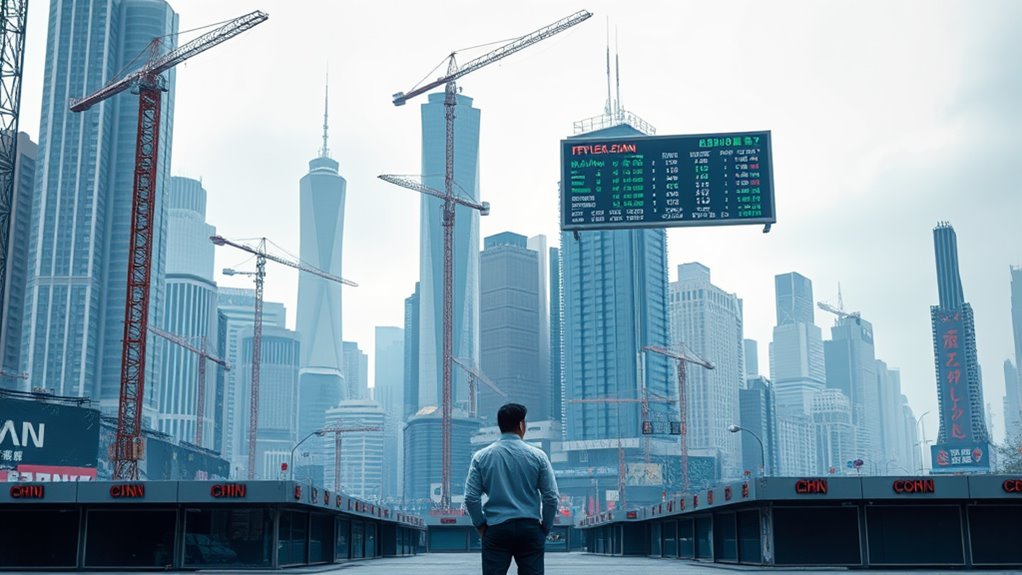
China’s Economic Slowdown: Real Crisis or Reshuffling Strategy?
Subtitle
The Scientific Journal for Everyone – When scientists speak human, people listen.
Summary
After decades of double-digit growth, China’s economy is entering a new phase—one marked by slower GDP growth, property sector turmoil, youth unemployment, and shrinking global demand. But is this a sign of deep structural crisis? Or is Beijing deliberately shifting toward a new economic model?
The answer is not straightforward. China’s slowdown reflects both real vulnerabilities and a purposeful strategic pivot. What’s unfolding may be less a collapse—and more a recalibration of how the world’s second-largest economy defines prosperity, stability, and power.
Why It Matters
What happens in China doesn’t stay in China. As the world’s largest trader, second-largest consumer market, and key link in global supply chains, its economic health has system-wide implications:
-
Commodity markets are tied to Chinese demand.
-
Manufacturing chains depend on Chinese production and exports.
-
Global growth often hinges on Chinese stimulus during downturns.
-
Geopolitical tensions (especially with the US) shape investor sentiment and policy risks.
-
Green transitions depend heavily on China’s solar, battery, and EV sectors.
In short: A slower China could mean a slower, more fragmented global economy—unless the transition is managed with care.
What the Research Shows
-
GDP growth is slowing structurally: After growing at 9–10% annually from 1980–2010, China’s economy expanded just 4.9% in 2023 and is forecast around 4.5% in 2025, below government targets (IMF, 2024).
-
Property sector is a key drag: Real estate once made up nearly 30% of GDP (directly and indirectly), but defaults by Evergrande, Country Garden, and others have frozen investment and hurt household wealth (CEIC, 2024).
-
Youth unemployment reached record highs: In 2023, official youth unemployment exceeded 20%, prompting the government to suspend publication of data temporarily (NBS, 2024).
-
Private sector confidence is low: Crackdowns on tech giants, private tutoring, and foreign consultancies have contributed to a climate of uncertainty in business circles (CSIS, 2024).
-
Demographics are a headwind: China’s population peaked in 2022 and is now declining, raising concerns about labor shortages, pension costs, and consumption potential (UN DESA, 2023).
Yet alongside these risks, Beijing is actively trying to shift toward high-tech, green, and domestic-led growth—suggesting that the slowdown is not entirely unplanned.
What’s Behind It
Understanding China’s slowdown means seeing both the symptoms and the strategy.
1. End of the Property-Driven Growth Model
For years, China relied on real estate, infrastructure, and credit to drive growth. That model led to debt accumulation, overcapacity, and housing bubbles. Today’s slowdown reflects a conscious attempt to deflate that system without collapse.
2. Pivot to “High-Quality Growth”
Under Xi Jinping, Beijing is emphasizing technological self-reliance, green innovation, and supply chain control—even at the cost of headline GDP.
3. Domestic Consumption as a New Engine
The government is trying to shift from export-led growth to a model based on internal demand and middle-class spending—but faces obstacles like high savings rates, weak social safety nets, and economic uncertainty.
4. Geopolitical Decoupling
US sanctions on semiconductors, tariffs, and export controls have pushed China to accelerate self-reliance in strategic industries—but also limited access to global markets and capital.
5. Political Centralization
Xi’s consolidation of power has led to greater policy consistency—but also less flexibility. Bureaucrats are more cautious, innovation may slow, and fear of overstepping hampers local decision-making.
In essence, this is not just a cyclical downturn—but the result of deliberate restructuring within a changing global and domestic context.
What’s Changing
China’s economic model is being re-engineered in real time:
-
Tech and green sectors are growing: Despite the slowdown, China now leads the world in solar panel production, EV sales, and battery exports—driven by massive state support.
-
State-owned enterprises (SOEs) are resurging: Beijing is re-centering SOEs in strategic industries, while private firms face tighter ideological and regulatory oversight.
-
Local governments face fiscal stress: With land sales declining and debt burdens rising, many provinces are scaling back infrastructure spending and struggling to fund public services.
-
Financial sector remains fragile: Hidden debt, shadow banking, and limited consumer credit options constrain recovery, despite monetary easing.
-
Global investor skepticism is rising: Foreign direct investment into China has declined for five consecutive quarters, as companies diversify toward India, Vietnam, and Mexico.
These shifts suggest that China’s slowdown is real—but part of a strategic economic rebalancing, not simply a loss of momentum.
Big Picture
China is not collapsing—but it is transforming. This shift carries both risk and opportunity for the global system:
-
Will China’s new model stabilize growth or slow it further?
-
Can the Communist Party maintain control amid economic strain?
-
Will the world adjust to a less growth-driven, more inward-facing China?
In short: China’s slowdown is not a pause. It’s a pivot—with global consequences.
Conclusions
The narrative of China’s economic crisis is both overstated and incomplete. What we are witnessing is not the end of China’s rise, but a recalibration of its trajectory.
1. The slowdown is structural—but not catastrophic
A mature economy cannot grow at 8–10% forever. The shift toward 4–5% growth reflects demographic changes, global conditions, and domestic goals—not failure.
2. Reform is real—but risky
China is trying to transform its growth model while maintaining social stability and political control. That’s a high-wire act, and policy missteps or shocks could tip the balance.
3. The world must adjust to a different China
The era of China as the engine of global growth and low-cost supply is ending. Supply chains, financial markets, and climate diplomacy must rethink their assumptions.
4. Internal contradictions remain unresolved
China wants innovation, but controls speech. It wants consumption, but weakens social trust. It wants global leadership, but resists openness. These tensions may limit its new model’s success.
5. China’s next phase is about power, not pace
Slower growth doesn’t mean less ambition. China is focused on technological dominance, geopolitical leverage, and economic self-sufficiency—metrics that don’t show up in GDP, but reshape the world nonetheless.
The deeper lesson
Don’t mistake deceleration for decline. China is not falling—it’s repositioning.
The question is no longer “Will China collapse?” but “What kind of power is it becoming—and how should the world prepare?”
Economic strategy is becoming geopolitical doctrine. The slowdown is just the surface.
Sources
-
IMF (2024). China Country Report
-
CEIC Data (2024). China Real Estate Indicators
-
National Bureau of Statistics of China (2024). Youth Employment and Labor Market Trends
-
UN DESA (2023). World Population Prospects
-
CSIS (2024). China’s Private Sector in Transition
-
World Bank (2024). China Economic Update
Q&A Section
Is China in a recession?
No. Growth is slowing, but the economy is still expanding—just more slowly than in past decades.
Why is youth unemployment so high?
A mismatch between graduate skills and job market needs, plus a weak services sector and shrinking private hiring amid tech crackdowns.
Will China stimulate the economy like in 2008?
Unlikely. Beijing is wary of debt-fueled infrastructure binges and instead prioritizes targeted, strategic investment.
Is China turning inward?
Partially. It’s pushing for self-reliance in tech and industry, but still heavily integrated into global trade—especially in green tech.
What does this mean for Europe?
Expect slower export demand, increased competition in green tech, and growing tensions over industrial subsidies and data governance.
