
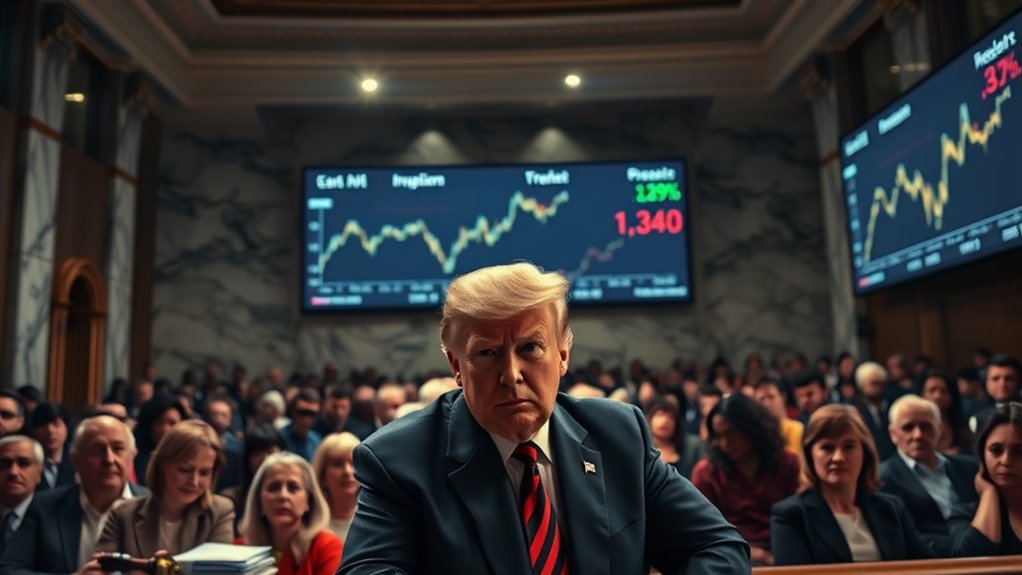
Trump on Trial: The Economic Stakes of Political Drama
Subtitle
The Scientific Journal for Everyone – When scientists speak human, people listen.
Summary
As former U.S. President Donald Trump faces multiple trials in 2025, the story may appear to be about legal accountability and political fallout. But behind the courtroom drama lies a set of profound economic consequences—from market volatility and investor uncertainty to fiscal risk, institutional trust, and policy paralysis.
This isn’t just a political crisis. It’s a test of how democratic institutions interact with financial systems—and what happens when law, power, and capital collide.
Why It Matters
What happens in the U.S. reverberates globally. When a former president is put on trial while running for office, institutions are tested, and markets pay attention:
-
Investor confidence wavers in the face of constitutional uncertainty
-
Public trust in justice, elections, and policymaking erodes
-
Economic policy is deprioritized or blocked by political conflict
-
Geopolitical rivals exploit the distraction or division
-
Social unrest risk increases, with implications for spending, policing, and insurance markets
In short: When politics destabilizes institutions, the economy absorbs the shock.
What the Research Shows
-
Political uncertainty depresses investment: Evidence from past U.S. crises (e.g. Watergate, 2000 election recount) shows that corporate investment slows during periods of constitutional instability (Bloom et al., 2014).
-
Trials of political leaders polarize consumer sentiment: Public opinion becomes more divided, impacting spending behavior and financial risk-taking, particularly among partisan lines (Gallup, 2023).
-
Democratic backsliding increases borrowing costs: Credit rating agencies and bond markets react negatively when rule-of-law institutions appear threatened, even in wealthy democracies (IMF, 2022).
-
Prolonged legal sagas clog the policy agenda: Legislative deadlock and weakened executive capacity delay infrastructure, tax, and social programs, undermining economic planning (Brookings, 2023).
-
Global markets follow political signals: U.S. legal drama influences global dollar strength, capital flows, and regulatory harmonization, especially in sectors like tech and energy (World Bank, 2024).
The economic effects may not be immediate crashes—but slow erosion of confidence, clarity, and coherence.
What’s Behind It
The Trump trials matter economically not just because of who is on trial, but because of what the trials symbolize and trigger.
1. Legal Uncertainty as Economic Risk
Markets thrive on predictability. Ongoing trials introduce ambiguity into the election calendar, policy outlook, and leadership succession.
2. Media Saturation Crowds Out Economic Debate
With 24/7 coverage of court proceedings, other issues—inflation, jobs, energy, trade—take a backseat, undermining policy focus.
3. Erosion of Institutional Trust
If the justice system is seen as partisan—by either side—faith in neutral governance collapses, harming everything from tax compliance to investment.
4. Populist Policy Shifts
Trials may embolden Trump’s base or critics to push more extreme policies—fueling regulatory whiplash, especially in climate, tech, and trade sectors.
5. Market Manipulation Risk
Volatility around trial developments opens doors to speculation, misinformation, and asset manipulation—particularly in politically sensitive stocks or sectors.
This is less about a single verdict—and more about the cumulative stress of prolonged democratic turbulence.
What’s Changing
Several structural dynamics make these trials more economically consequential than past political scandals:
-
Election year convergence: Trials coincide with the 2025 U.S. presidential election, turning courtrooms into campaign arenas.
-
Global observers are watching: Allies and rivals alike are assessing whether U.S. institutions can enforce law without sparking collapse.
-
U.S. fiscal gridlock is deepening: With Congress increasingly polarized, legal drama limits scope for debt ceiling negotiation, stimulus planning, and tax reform.
-
Social media intensifies reactions: Trial-related content drives rapid mood swings in consumer and investor sentiment.
-
Right-wing populism is transnational: Trump’s legal troubles are echoed by similar narratives in Europe, Brazil, and India—linking judicial accountability to economic nationalism.
We’re seeing an unprecedented fusion of courtroom risk, political theater, and macroeconomic exposure.
Big Picture
This moment is not just about the future of Donald Trump. It’s about:
-
Whether rule of law can survive hyper-partisan interpretation
-
Whether financial systems can remain stable amid democratic volatility
-
Whether institutions can deliver justice without triggering economic backlash
In short: This is a stress test for democratic capitalism—can it hold under pressure from within?
Conclusions
The Trump trials expose a rarely discussed truth: political institutions are economic infrastructure.
To mitigate long-term damage, we must understand:
1. Stability is not just about markets—it’s about institutions
When courts, elections, and law enforcement are politicized, economic systems wobble, even without a recession.
2. Economic policy needs insulation from legal drama
The U.S. must find ways to separate governance from spectacle, ensuring continued functioning of agencies, programs, and economic plans.
3. Global perception matters
The U.S. dollar, treasury bonds, and stock markets are global reference points. If the world perceives democratic decay, it may diversify away from U.S. assets.
4. Media literacy is economic security
Public confusion, conspiracy, and disinformation can lead to consumer panic, investor overreaction, and market volatility. A well-informed public is a stabilizer.
5. Accountability must not come at the cost of legitimacy
Regardless of verdicts, the justice system must be seen as fair, transparent, and restrained—or else economic trust collapses alongside political trust.
The deeper lesson
In stable times, markets and politics operate in parallel. But in crisis moments, they collide.
The Trump trials represent more than legal reckoning—they are a global case study in how power, law, media, and money intertwine.
Democracy must show that it can hold leaders accountable while keeping economies functional. Otherwise, the cost of justice may be confusion—and the cost of confusion may be confidence.
And without confidence, no economy thrives.
Sources
-
Bloom et al. (2014). Political Uncertainty and Investment Behavior.
-
Gallup (2023). Polarization in Economic Expectations.
-
IMF (2022). Rule of Law, Institutions, and Sovereign Risk.
-
Brookings Institution (2023). Executive Constraints and Fiscal Gridlock.
-
World Bank (2024). Geopolitical Shocks and Financial Channels.
-
Pew Research (2025). Public Trust in U.S. Institutions.
Q&A Section
Will the Trump trials cause a recession?
Not directly. But if trials paralyze policymaking or deepen social unrest, they could worsen existing economic fragility.
Are investors watching this?
Absolutely. Political risk analysts and institutional investors are tracking court dates, public reactions, and election implications closely.
What happens if Trump is convicted—and still runs?
Markets hate uncertainty. That scenario introduces legal ambiguity, electoral chaos, and possible constitutional crisis.
Could this affect the U.S. credit rating?
If governance appears weak or unpredictable—yes. Institutional dysfunction can raise borrowing costs, even for advanced economies.
Is this just a U.S. issue?
No. It affects global financial confidence, democratic norms, and strategic alliances—making it a truly international concern.
